Posts Tagged ‘speakers’

Act Up Or Sit Down!

Tuesday, November 3rd, 2009
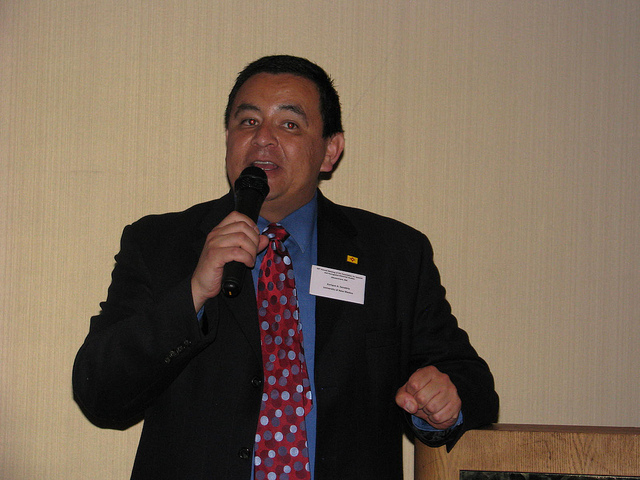
Photo CreditIf You Aren't Acting While You Are Speaking, Then Sit Down

If You Aren't Acting While You Are Speaking, Then Sit Down

When I come to hear you speak, no matter if it’s at a departmental project status report or at a local restaurant or even if it was at a convention, the worst thing that you can do is to waste my time. What are you going to do about this?

Why So Many Speakers Suck

Let’s be frank here – most speakers that you listen to really aren’t that good. In fact, the ones that we think are good may not really be all that good – they may just be better than the ones who are really bad! What’s going on here? It’s actually pretty simple, most speakers are boring. Who wants to listen to that?

All too often a speaker will focus exclusively on what they are going to be saying and spend little or no time thinking about how they are going to say it.

If you need an analogy to clear things up, this would be like a chef who worries about what ingredients go into a meal without spending any time thinking about how to actually cook the thing. Sure he’ll be able to make something, but it’s not going to taste very good.

Fixing The Problem Of Your Boring Speeches

You are in a rut. You’ve found a particular speaking style that you believe suits you (that means that it worked once and you’ve stuck with it ever since) and you have become what we all fear the most – a boring speaker. How are we going to fix this problem?

You are going to have to take action. You are going to have to start to experiment with the unknown. You are going to have to step into the world of theater.

Birgit Starmanns has spent time in both the world of speaking as well as the world of theater. She points out that actors spend their time working hard to allow the audience to feel what the actor is currently feeling. In order to make this happen they use six tools:

  • Quotes: quotes are a powerful way to invite someone else into your speech. All too often speakers just stick any old quote into their speech in order to give themselves credibility – don’t do that. Instead, make sure any person that you invite into your speech by using their quote helps to move your speech along and gives you more creditability with your audience.
  • Roles: It’s just you up there and that can get pretty boring for your audience. How about if you stop being you for a bit and turn into someone else? You need to make it very clear to your audience that you are doing this, otherwise they are going to think that you’ve all of a sudden lost it. I’ve used this during internal status reports in order to bring the voice of other departments (e.g. finance) into my presentation.
  • Props: This is one of the simplest things to use, and yet all too few speakers take the time to think about what props would help them get their point across. In the past during presentations to sales teams, I’ve used marketing brochures from their competitors that they instantly recognized in order to drive a point home.
  • Staging: I hate it when a presenter acts like a block of stone and stands in one place during an entire presentation. You’ve got the entire stage / front of the room / etc. – use it! In fact, as you move from section to section in your speech, move to a different spot to speak and your audience will understand that you’ve moved on in the speech.
  • Costumes: Ok, so you’ve got to be careful here depending on your audience, but you should at least consider it for every speech that you give. I’m not talking about a full on Hollywood costume, but rather wearing something that will enhance your message. I’ve used a chef’s hat during a presentation to show that we were “cooking up” some new products to sell – you get the point.
  • Audience Participation: Do you feel lucky? Well, do you? Bringing someone from your audience up on stage during a presentation is a huge risk. However, it’s a great way to capture everyone’s attention – they will all be breathing a sigh of relief that it wasn’t them that got picked. If you are ready to interact well with you victim, I mean volunteer, then your speech definitely won’t be boring.

Final Thoughts

Anyone can give a boring speech – don’t let it be you. You’ve got to realize that no matter the setting in which you’ll be presenting in, be it a boardroom or a convention hall, you are ultimately putting on a performance for your audience.

Not everybody is a born entertainer, but that’s ok. Where you’ll really tick me off is if you don’t at least try. Theater actors have to connect with their audience every time they put on a show. In order to do this they pull out all of the stops and use every device that they have available to them in order to make their performance unforgettable.

You need to learn from them, research their techniques, and then apply them to your next speech where appropriate. You may not turn into the next Robert De Niro or Glenn Close, but that doesn’t matter. You won’t be giving boring speeches anymore and that’s all that matters…!

What’s the one thing that you can do to make your next speech unforgettable?

Click here to get automatic updates when The Accidental Communicator Blog is updated.

What We’ll Be Talking About Next Time

Bored audiences will get up and walk out of your speeches. How would you keep the attention of 400+ engineers who were attending an industry dinner event that they didn’t really want to be at on a weekday evening? I recently had the opportunity to be the master of ceremonies at such an event – great gig, tough crowd.

Know Your Audience: What You Don’t Know May Hurt You

Tuesday, September 15th, 2009
Speakers Need To Realize Their Audience May Be Different From Them <p>(c) - 2008</p>

Speakers Need To Realize Their Audience May Be Different From Them (c) - 2008

When you think of the perfect speech in your mind, what do you see? Do you see yourself up on a stage giving a speech, reaching the end, and then having everyone stand up and applaud until their hands grow tired? Nice picture. However, all too often that doesn’t happen. There are lots of reasons for this, but one big one is because we don’t take the time to fully know our audience

Why Bother?

Why give a speech in the first place? There always has to be a reason for us to give a speech – are we there to entertain, inform, motivate, etc. We won’t be able to do this if we don’t connect with our audience. We won’t be able to connect with our audience if we don’t know who they are.

It’s way too easy for a speaker to make assumptions about the audiences that we are talking to. The biggest mistake is to assume that they see the world the way that we do. Craig Harrison points out that by presuming that the audience thinks the way that we do we risk offending them – perhaps without even realizing it.

It Takes A Village To Give A Speech

The right way to go about getting an audience on your side is to tackle three big issues right off the bat in any speech that you are giving:

  • Acknowledge Differences: What makes you different from the majority of your audience? You realize this and your audience realizes it. Deal with it in a way that shows respect. If you are an older speaker talking to a much younger audience you could start out by saying “I realize that you are out there looking at me and thinking to yourself that I may be old enough to be your parent; however, don’t worry – I won’t be telling you that you should visit your mother more, that you really should be getting more sleep, or asking when you’ll finally be getting married. Instead, how about if we talk about…
  • Include Everyone: Not only are you an outsider to your audience, there is a good chance that a lot of people in your audience are outsiders to the rest of the audience. Use the opening of your speech to unite everyone together at least on a single issue. An example might be “I realize that we all live in different neighborhoods, go to different schools, and attend different churches, but the proposed change in how property taxes are calculated will affect us all and that’s what I’d like to talk to you about tonight.
  • Mind Your Reputation: Before you even open your mouth, the audience has pre-judged you. It might be based on the information that was used to advertise the event or perhaps you are known for some past deed. Dealing with this right off the bat will allow your audience to get by it and start to listen to what you have to say. One way to do this would be “I come from the sunny state of Florida where you might think that just about everyone is retired and just living off of Medicare. However, there are a few of us who are still working and we care just as much, if not more, about the current debate over healthcare reform…

Final Thoughts

Giving a speech is a tough job. Giving a good speech is even tougher. You need to have your audience working with you, not against you if you want to have any hope of making an impact. The first step in accomplishing this is realizing that your audience is different from you.

Once you acknowledge this, then you need to work to include them and dispel any preconceived ideas that they may have about you. Learn to do this well and you’ll be able to intimately connect with your audience and make an lasting impact in their lives.

Click here to get automatic updates when The Accidental Communicator Blog is updated.

What We’ll Be Talking About Next Time

Have you ever heard the expression “one size fits all“? Something that too many public speakers don’t realize is that you need to create different speeches for different size audiences. There is no such thing as the one-size-fits-all speech.

Persuasion Power – How To Win Over An Audience

Tuesday, August 4th, 2009
Speakers Who Can Persuade An Audience Are Powerful Indeed <br> (C) - Jason Cross

Speakers Who Can Persuade An Audience Are Powerful Indeed (C) - Jason Cross

Not all speeches are the same. Graduations, weddings, corporate pep-rally’s – those are all pretty straightforward. One of the most difficult types of speeches to give is one in which you have been brought in to convince an audience of something. As difficult as this type of speech is to give, if you can become good at doing it, you will seen as being a very valuable speaker indeed!

Persuasion Starts With Small Steps

You can assume that the audience that you’ll be speaking to will be be made up of a mix of people who already support your position, who have not make up their minds yet, and who are dead set against whatever you are going to say. Good luck with that presenter!

Clearly the first step in winning any audience over is for you to do your homework BEFORE you are facing the audience. One key area to research is to find out what arguments “the other side” has made. If there is a person or a group that represents “the other side”, then this is pretty straightforward. If there is not a clear “other side”, then you’re going to have to spend some time researching the flip side of what you want to persuade your audience about – because some people will have decided that that is what they want to believe.

One sure-fire way to start to win your audience over to your way of thinking is by using something called strategic agreement. When you do this  you agree with parts of the other side’s position. Automatically this will start to make the audience view you as a reasonable person. They may not completely agree with you, but they will start to warm to your view point.

Show Up Ready For A Fight

Well, maybe that’s putting it just a little bit too harshly. How about if we say that you need to show up ready to address your audience’s objections. Whatever you have been asked to convince them about, there will be objections to it. Before you give your speech, you need to once again do your homework. In your speech you need to make sure that you address these each of these objections.

Sometimes we like to shy away from sticky arguments that we don’t feel that we have a good response to. However, you must be careful to not do this. It turns out that if you don’t address an objection, then your audience will assume that it is a valid objection because you didn’t talk about it.

This Is A No Dumping Zone

I am probably more guilty of dumping than anyone else that I know. When I’m giving a persuasive speech, I want to make sure that I get my point across. This means that I’ll do a lot of research and, if I’m not careful, I’ll “dump” all of that research on my audience during my presentation. This is a bad idea.

Instead, you want to do the research, pick out the points that are going to be the most important to your audience, and then cover just these few points in detail.

What It Takes To Make A Good Argument

You would think that we’d all know this by now, but when I’m coaching speakers I keep discovering that they know WHAT they want to say to make their point, but they don’t know HOW to say it. It turns out that there is a simple formula that allows you to create a complete argument in order to support your position:

  • First: Make An Assertion – you’ve got to tell your audience what point you are going to be trying to convince them about. Without this, they’ll never know what you are talking about.
  • Next: Tell Them Why – this is where you need to explain to your audience why YOU think that your position is correct. This is the meat of your point and you really need to come across as convincing.
  • Finally: Show Proof - the fact that you believe something is great, but not enough. You need to wrap up your point by sharing evidence with your audience that will back up your position.

Final Thoughts

There is no doubt about it – winning people over to your way of thinking is just about the hardest type of speech to give. Ask any politician. However, it can be done. What it requires is that you do a lot of homework in order to prepare your arguments with an understanding of the facts and what your audience is currently thinking.

Public speaking is never an easy thing to do. Developing the skills that are needed in order to rally a crowd behind a new idea, a change in policy, or bold new idea is time well spent for a speaker. If you can do this, then you’ll have a powerful new speaking tool and you’ll be able to intimately connect with your audience and make an lasting impact in their lives.

Questions For You

Have you ever had to give a speech where you had to persuade the audience? Did you do enough homework to prepare for the speech? Did you find out what the audience was thinking before you gave your speech? How did it turn out? Leave me a comment and let me know what you are thinking.

Click here to get automatic updates when The Accidental Communicator Blog is updated.

What We’ll Be Talking About Next Time

If you are going to go to the effort of creating and delivering a speech, doesn’t it make sense that you’d want to be able to reach your audience and somehow appeal to them? No matter if you are trying to persuade them or educate them, ultimately the goal is find a way to successfully appeal to them. Good news – how to do this has been known for the past 2,500 years!

Persuade An Audience Using 3 Secrets Used By Presenters

Tuesday, July 28th, 2009
Persuading Your Audience Requires More Planning Than Yelling At Them

Persuading Your Audience Requires More Planning Than Yelling At Them

If you think about it, there are a lot of different types of speeches that we can give: humorous, informative, motivational, and of course, ones that are designed to get your audience to start thinking a particular way. Oh yeah, this last type just may be the hardest type of speech to give

Where Do You Start When You Want To Persuade?

At it’s very heart, persuasion is the art of getting your audience to see the world the same way that you do. As all of us speakers know, no matter if you are talking to a graduation or a business gathering, an audience is not a single entity – it’s a lot of different people sitting out there who all have different opinions on any given topic. Your job as a speaker is to win over as many of them to your side as possible.

Pick Your Problem

John Coleman is an author and a former U.S. national speech champion who knows a thing or two about how to build a speech that can persuade. Coleman points out that before you can have any hope of persuading an audience, both of you need to agree that there is a problem in the first place.

As obvious as this may seem, you could talk until you are blue in the face and it would all be for naught if your audience didn’t agree with you that there is a problem. In order to get your audience to agree that there is a problem that needs to be solved, you need to do three things:

  • Isolate it & limit its scope
  • Make it urgent
  • Make it significant

You Got To Keep ‘Em Isolated

Have you ever heard that phrase “You can’t boil the ocean”? When it comes to persuading an audience it applies – you need to make sure that you pick a problem that you can actually do something about. Scope down a bigger problem (“world hunger”) to something that your audience can do something about (“hunger in our town”).

Run!

Well, don’t run but you do want to convince your audience that they need to take action. Just talking about a problem isn’t enough to cause your audience to actually agree to DO anything. Somehow you are going to have to lite a fire underneath them so that they will end up taking some action (that’s why it’s called “persuasion”!).

It’s Only A Problem If It’s Significant

Assuming that you’ve been able to convince your audience that there is a problem, your next step is to make sure that you bring it home – you’ve got to relate the problem to their lives. This is going to require that you have an understanding of who your audience is so that you can describe to them how this problem is going to affect them in terms that will motivate them to take action.

Final Thoughts

Speeches that persuade are not easy speeches to give. However, as with so many things in life – it’s the ability to do the hard things that make us more valuable. If you take the time to understand how to prepare to give an effective persuasive speech, then you’ll have a powerful new speaking tool and you’ll be able to intimately connect with your audience and make an lasting impact in their lives.

Questions For You

Have you ever had to give a persuasive speech? Was the problem too big, too small, or just the right size? How did you convey that the problem was urgent? Did your audience come away believing that the problem related to their lives? Leave me a comment and let me know what you are thinking.

Click here to get automatic updates when The Accidental Communicator Blog is updated.

What We’ll Be Talking About Next Time

Not all speeches are the same. Graduations, weddings, corporate pep-rally’s – those are all pretty straightforward. One of the most difficult types of speeches to give is one in which you have been brought in to convince an audience of something. As difficult as this type of speech is to give, if you can become good at doing it, you will seen as being a very valuable speaker indeed!

More Information

Handling Hecklers: 5 Ways That Presenters Can Restore Order

Tuesday, July 21st, 2009
All Speakers Need To Find Ways To Deal With Hecklers

All Speakers Need To Find Ways To Deal With Hecklers

How does that children’s rhyme go?

“Sticks and stones will break my bones, but words will never hurt me”.

Bull! If there is one thing that presenters dread more than forgetting their lines, it’s having someone add to their speech without an invitation. Unlike President Obama we don’t have a flock of Secret Service agents at our beck and call who can fan out into an audience and cart off an unruly heckler.

What should you do when someone in the audience starts to deliberately take away from your carefully rehearsed speech? Start crying and go home is always a possibility; however, I’ve got some better ways to deal with this situation for you…

What Is Heckling?

Maybe a good place for us to start this discussion is to make sure that we both fully understand just what heckling is. There are two types of heckling that you WILL have to deal with during one or more of your presentations: active and passive.

Active heckling occurs when someone in the audience starts talking back to you right in the middle of your speech. For a public speaker this often feels like you’ve just hit  a speed bump in your speech while you were going 80 miles an hour. Talk about surprising!

Passive heckling is much closer to disrespect. This often shows up as people having their own conversations during your presentation. Normally this is their own call and you don’t really care, but if they are loud enough then it becomes your problem. Talking on  a cell phone or having a huddle at the back of the room are common ways that this shows up.

No matter if you are speaking at a wedding, a graduation, or a business function, hecklers will ALWAYS be in the audience and it’s just a matter if they decide to speak up. First off, we should talk about what you should NOT do…

What Should You NOT Do?

I sorta like to think of this as the North Korea problem – man they are annoying, but they are so small as to not really count in the big scheme of things. Likewise, when you are faced with either an active or a passive heckler, you need to make sure that you don’t come out with guns ‘a blazing. Here are a few things that you should NOT do when you are trying to deal with a heckler:

  • Don’t try to be funny: this is the #1 response that trips up most presenters. They spend too much time trying to come up with a funney response to the heckler on the spot and it falls flat. A serious response will shut him/her up most of the time.
  • Don’t Lose Your Temper: I don’t care if you were just coming to that point in your speech which causes everyone to burst into tears and now this rude heckler has spoiled the moment. If you lose your temper, then you’ll never be able to get back into your speech after the moment has passed.

How To Correctly Handle A Heckler

Some hecklers are a one-shot deal – they make one comment and then they’ll go away forever. However, depending on what they’ve said, even this type of heckler needs to be dealt with. Dealing with all types of hecklers correctly is the key to being a successful public speaker. Here are 5 ways that you can deal with hecklers during your speech:

  1. Silence: Somewhat surprisingly the simplest solution is often the most effective. If you stop speaking and turn and stare at the heckler, everyone else will turn to see what you are looking at. In 95% of heckler cases this kind of social embarrassment is all that it takes to shut a heckler up.
  2. Tie Your Response To The Event: This is a clever way to remind the heckler why everyone is at the event. For example, if you were speaking at a breast cancer awareness event and started to have problems with a heckler, a great response would be “Hey, I’m talking here – unless you’ve discovered a way to beat breast cancer, how about if you just remain quiet”.
  3. Add The Heckler To Your Team: This technique turns an unexpected interruption into what appears to be a planned part of your speech. After the heckler has said what they are going to say, pause for a moment and thank your “speechwriter / joke writer / etc.”. The audience will laugh with you, the heckler will beam with pride, and you can go on.
  4. Give Them The Mic: This is a fairly drastic tactic, but it can pay great dividends. Walk over to where the heckler is sitting and offer to hand them the mic. Generally they will decline the offer and will get the point that this presentation is not all about them.
  5. Think Outside The Room: Certain hecklers, such as loud groups at the back of the room, can resist all efforts on your part to overcome them. This calls for innovative thinking. One way to handle this is either for you or your audience to move. You can move out into the center of your audience and deliver your speech “in the round” or you can have them move their chairs in order to be closer to you.

Final Thoughts

When I’m starting a speech, I always try to keep in mind that there are two groups in the room - me and everyone else. A heckler poses a unique problem in that if not dealt with correctly, he/she can drive a wedge in between me and my audience.

Ultimately what a great speaker tries to do is to separate the heckler from the rest of the audience so that there are three groups in the room: you, the audience, and the heckler. If you can accomplish this, then you’ll be able to silence the heckler while at the same time intimately connecting with your audience and make an lasting impact in their lives.

Questions For You

How big of deal are hecklers for you during your speeches? Have you ever had to deal with active / passive hecklers? How much “force” did you have to use? Did it work? Leave me a comment and let me know what you are thinking.

Click here to get automatic updates when The Accidental Communicator Blog is updated.

What We’ll Be Talking About Next Time

If you think about it, there are a lot of different types of speeches that we can give: humorous, informative, motivational, and of course, ones that are designed to get your audience to start thinking a particular way. Oh yeah, this last type just may be the hardest type of speech to give